Felton - Part 1
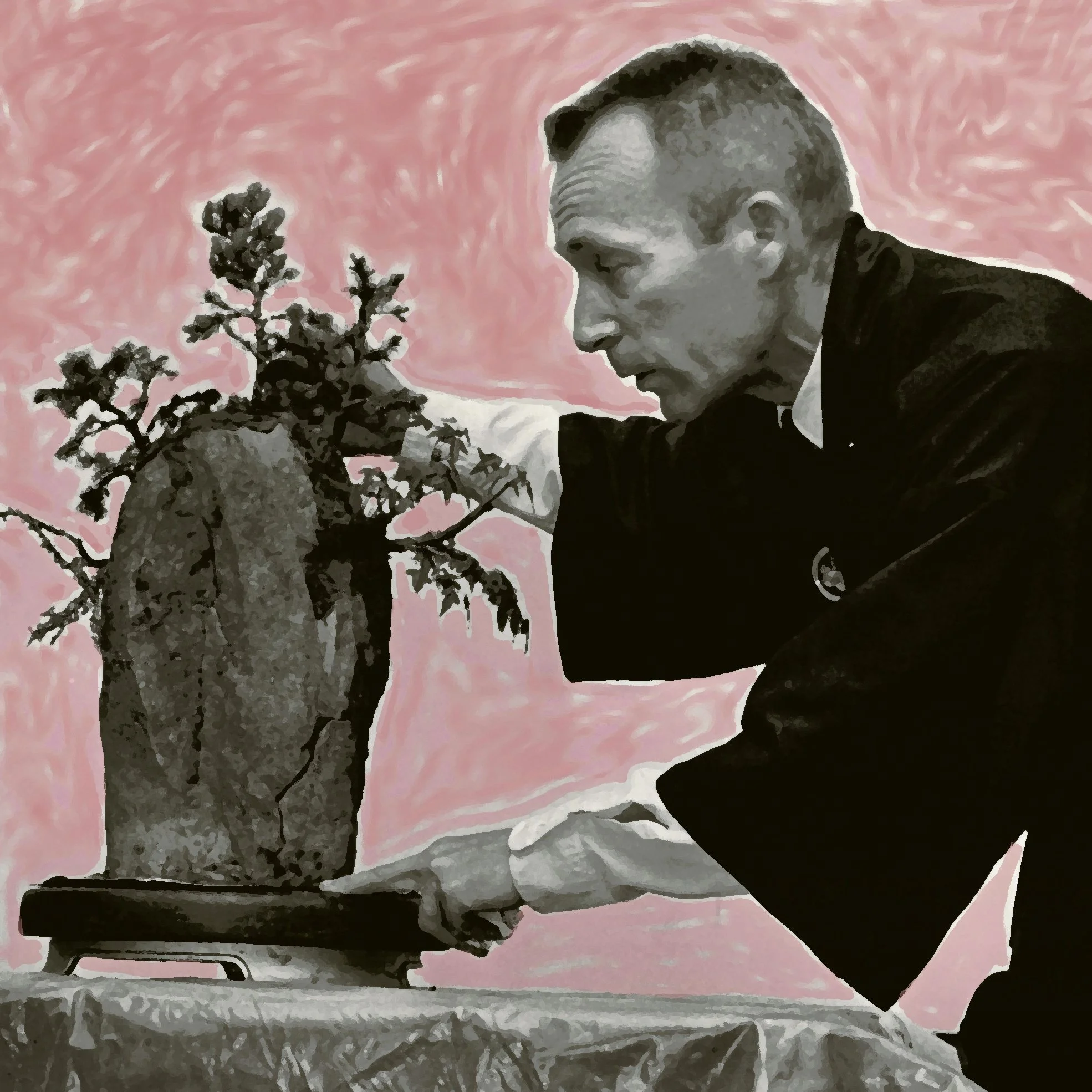
E. Felton Jones was one of a kind. If ever the term unique individual applied to anyone, it applied to him. I only ever knew Felton as an old man, and I partly believe he was always an old man, most likely having been born in that condition. He'd often recount how one of his early bonsai teachers told him, "Felton, you're an old man trapped in a young man's body!" So maybe he was young once, but by the time I met him he was an old man for certain, inside and out. I made contact with Felton on my first visit with the Triangle Bonsai Society in Raleigh, North Carolina, in 1995. He was that group's resident sensei and he would have been about seventy four years old at the time. I had heard his name before that, though, because it seemed all the bonsai people of the day knew Felton.
Fewer and fewer people remember Felton any more. He died in 2007, but people were already forgetting him in the years before he died. He felt that way at least, and told me so himself on more than one occasion. Felton was humble, he was unassuming. He spoke softly, seemingly never lost his temper, and carried an air of wistful sadness perpetually about him. He was the kind of person who could walk into a crowded room and completely disappear. Felton was a lifelong bachelor and when I met him he was living with his mother in Durham, taking care of her in her final years. Felton remained in that same old house when his mother finally passed away, anxiously watching out the windows as the neighborhood all around him declined and became seedy. He was lonely.
In the long ago, nearly impossible to imagine days of his youth, Felton was footloose and fancy free. As a child he was enraptured by the world of nature. He was a native North Carolinian and attended Duke University for a time, studying botany, before being lured away by the promise of a sunny life in Florida. Felton lived and worked for several years in Florida, then returned home with the intention of finishing his senior year at Duke. Adventure called him away again in 1950, when he accompanied a friend on a drive to Los Angeles. Felton stayed and lived for nearly a decade in California and it was there that bonsai entered his life. Felton fell in with Frank Nagata, a famous West Coast bonsai artist and teacher who owned a nursery and was one of the founders of the Golden State Bonsai Federation. Through Mr. Nagata he met and became a student and friend of John Naka, one of the original greats of American bonsai.
When Felton returned to North Carolina in the early 1960s, he set up shop in the town of Mathews, opening the Little Pines Bonsai Nursery. There was no organized bonsai presence in North Carolina at that time, so Felton took it upon himself to get it going. He showed some of his little trees at the 1964 Southern Spring Home and Garden Show in Charlotte. This drew the attention of several people in the area who already had the attraction to bonsai, but were pursuing it on their own in isolation. They soon became Felton's students at Little Pines. That small group then formed the Bonsai Society of the Carolinas, the first such entity in North or South Carolina, and made Felton Jones the club's first president. In effect, Felton put bonsai on the map in this part of the country.
Felton's influence shifted westward in 1967 when he relocated to Atlanta, Georgia. He was hired by Piedmont Park (which later became the Atlanta Botanical Garden) to design and oversee construction of their Bonsai and Japanese Garden. Shortly thereafter, Felton became a director of the American Bonsai Society and served in that capacity for nine years. He continued his work as a teacher and hit the circuit as a traveling bonsai professional, appearing at many of the early bonsai conventions and symposia in the United States. Felton also traveled all over the country to visit with bonsai clubs and study groups and had numerous private students. His most famous student is Rodney Clemons, who, despite now being in semi-retirement after his own long career, remains one of the most popular and respected American bonsai artists.
The latter part of the 1960s, right on through the 1970s and into the 1980s, was Felton's heyday. These were the exciting formative years of bonsai in our country and Felton was right in the middle of it. Yuji Yoshimura and Felton's old teacher John Naka formed the front rank of the movement and in their wake followed a first generation of talented home-grown bonsai teachers, many of whom were students of the two big leaders. Bonsai clubs cropped up in cities across the country and some of those began forming into larger regional organizations. The bicentennial gift of bonsai from the people of Japan to the people of the United States in 1976 was a watershed event, resulting in the creation of the U.S. National Bonsai and Penjing Museum in Washington, DC. Bonsai was riding a surging wave of popularity in America in those years. Judging by the articles I've read in bonsai periodicals of the day, the people caught up in this wave envisioned a bright future where bonsai would continue its remarkable growth in public appeal. There was no way of knowing where it would all end up.
The future never goes the way anybody imagines it. Bonsai is alive and well in the United States, but it remains a niche interest and I suspect it always will be. Those heady days of the 70s and 80s turned out to be more hopeful than prescient. For Felton, the tide began to ebb as he moved from middle age into his senior years. He continued to be a traveling teacher and was well liked and respected, but the frequency of invitations to be a guest at the big regional shows or to come to some town or another for a weekend with the local club began to subside. By the time I met him in 1995 his sun had largely set. Felton had moved back to North Carolina to take care of his mother, which limited his ability to travel anyway, and a younger generation of bonsai professionals had elbowed him out of the picture.
The members of the Triangle club venerated Felton and they eagerly endorsed him as someone with whom I should connect. It seemed a natural fit as I was engaged in the mission of building a public bonsai collection for the state of North Carolina and he was the state's favorite bonsai son. Felton had two bonsai attributes I sorely lacked — knowledge and experience. He wanted to be helpful to me if he could. I was impressed by his resume and glad for his willingness to help, so I took him up on the offer. At the first Carolina Bonsai Expo in 1996 I invited Felton to do a demonstration, and although I had no budget for the event and could not pay him, he readily accepted.
A great deal of work went into publicizing that first Expo and it paid off. We had Felton's demonstration program scheduled in a prime-time slot on Saturday afternoon, and when showtime came we had a full house. There were one hundred seats set up in the auditorium. As the program began every one of those seats was occupied. Felton's demeanor onstage was exactly as it was any other time, which is to say he was low key, soft spoken and slow moving. He started out by noting the large audience and thanking everyone for attending. Then he asked for a show of hands to indicate how many people in the audience were attending their first bonsai demonstration. Nearly everyone raised their hand. Felton expressed his gratitude for the enthusiastic crowd of first-time attendees and said he hoped that perhaps for some of them it would be the start of a lifelong enjoyment of the art of little trees.
Felton's demonstration subject was a trident maple, and the tree sat on a turntable before him as he began to speak. Felton told a story. I forget what the story was, but it was long and meandering and he told it slowly. His voice was soft and even with amplification from the mic he was wearing it was sometimes difficult to hear him. His vocal cadence was flat and his stage presence was minimal. Felton's first story led to another and then another, and although his stories were not without purpose and he was imparting information all the while, it was hard to stay with him. The maple tree sat untouched and I could feel the air leaving the room. Finally I had to get up and get out of there myself, on the pretense of needing to attend to other business, because I couldn't stand it anymore. I stayed away for about fifteen minutes and when I returned Felton was still holding forth in exactly the same monotone manner with the little maple still sitting nearby, untouched. I looked around the room and saw numerous empty seats. I wanted to call out, Hey, how about working on the tree??! Of course I couldn't do that and wouldn't do that, so I left the room again. I returned after another twenty minutes or so and nothing had changed, except there were even more empty seats. I had to leave again. Eventually I checked in and found Felton finally working on the tree, but now more than half the audience was gone. By the end of the program, which probably ran about two hours, the room was virtually empty. Only a few hardy souls remained and they were all steadfast friends of Felton's.
I was flabbergasted. The whole purpose of the Carolina Bonsai Expo was to establish The North Carolina Arboretum as a center for bonsai in the Southeastern United States, bringing together the various regional bonsai clubs and hopefully cultivating an engaged hometown audience. An auditorium filled with one hundred potential new bonsai supporters had been emptied out. How many of those people could be reasonably expected to give bonsai a second try? All the same, at the end of the demonstration I went up to Felton and complimented him on the tree he had done, thanking him for generously lending his name and reputation to our new event. He seemed oblivious to the disaster that had just taken place.
I never said anything further to Felton about that demonstration, but it provided me with a valuable, albeit painful, lesson. I made a vow to myself that I would never again put someone onstage who did not have the ability to hold an audience, the ability to entertain as well as educate. I never did, either. That meant I could never again chance putting Felton in front of an audience at the Arboretum, which was too bad. As it turned out, in the next few years Felton Jones would prove to be a singularly important friend to bonsai at The North Carolina Arboretum. And he would do it in his own quiet way, through an act of surprising heroism.
To be continued...
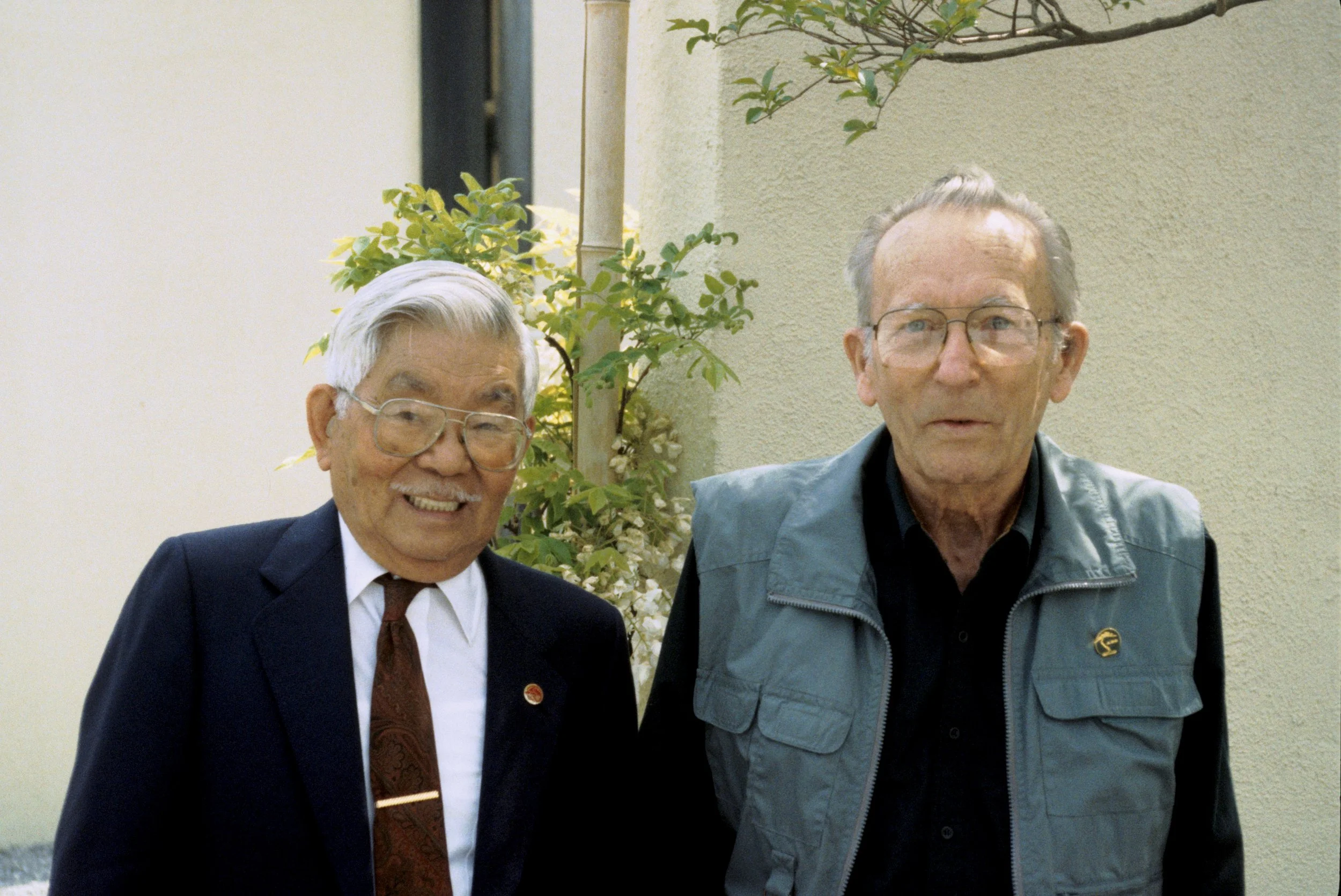
John Naka (left) and E. Felton Jones at the U.S. National Bonsai and Penjing Museum, 1996