Designing the Bonsai Garden - Part 3, the Landscape
Architect Bill Dechant's scale model of the bonsai facility we were planning made the hoped-for impression at the 1999 Carolina Bonsai Expo. Up until that point, bonsai people in our region knew only that the Arboretum committed to the project and had been working on it, but they had yet to see any tangible evidence of what was being planned. The model provided a sense of the seriousness of our intent and the scope of our ambition. We wanted to let the bonsai community know what we were envisioning because we were going to need their active support when it came time to raise the funds required to build it.
The state of the garden's design at this point included only the basic footprint of the facility and its larger structural elements. There was still a world of details to be worked out. For example, we knew the garden would have a water feature, but what would that feature look like? What kind of decking should we use on the boardwalk? We planned to have display benches lining the garden's walls, but how would those benches be built; what would be their dimensions and with what material would they be constructed? Early on we had decided the facility was going to be a garden, rather than something more along the lines of an outdoor museum or gallery. There had been no work whatsoever done in the initial design sessions to address the horticultural personality of that garden, the plants that would be used or how they would be employed. When the Expo was over, Bill's model was put away and the design team went back to work. Once more, intensive monthly meetings were conducted and the process moved briskly forward.
Even as the hardscape details were being addressed, planning for the landscape began rising to the top of the agenda. This shift in emphasis was accompanied by the introduction of a new member to the design team who would prove to be a positively critical contributor — Masashi "Mike" Oshita.
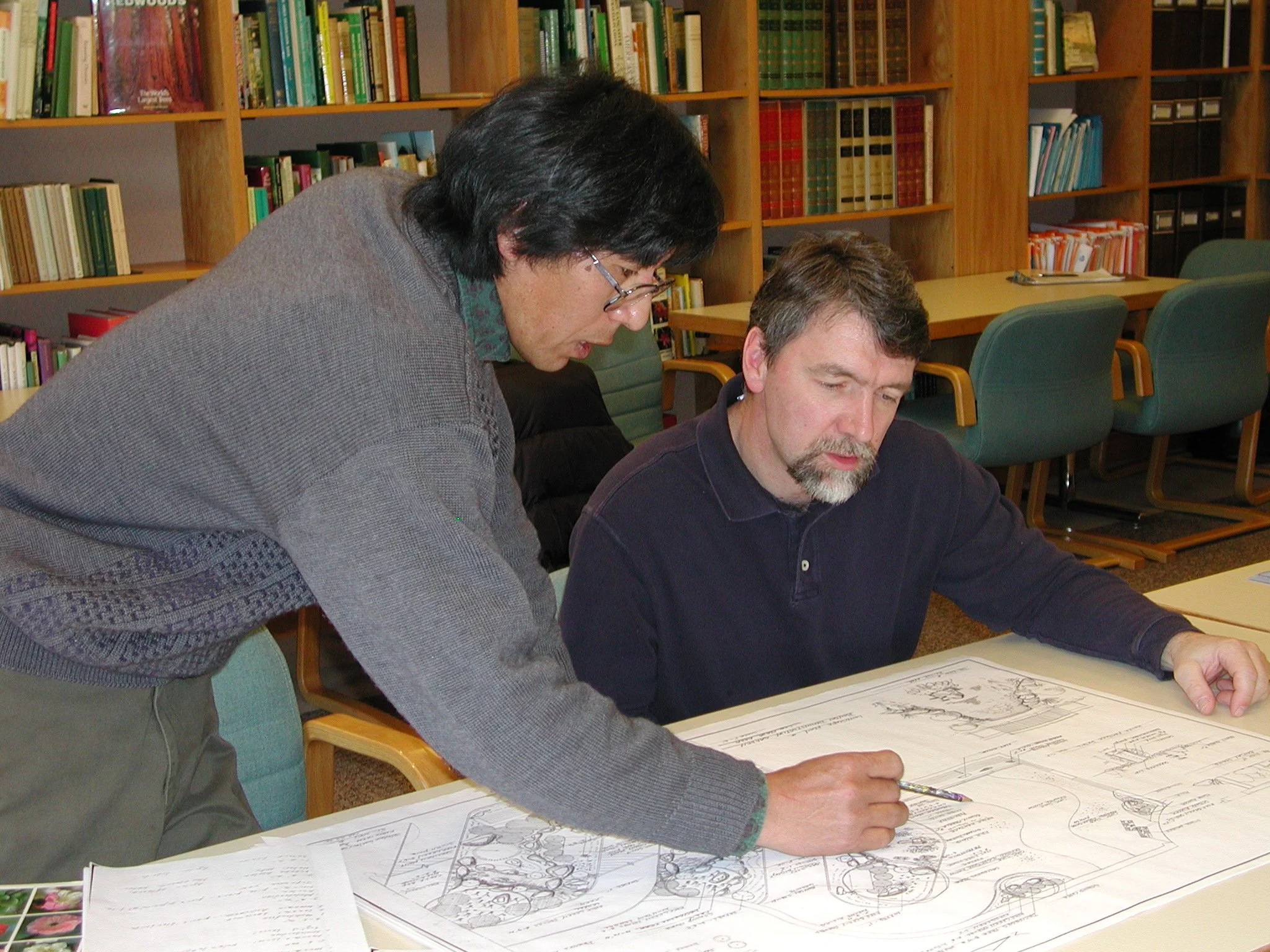
Mike Oshita (left) and Bill Dechant
I had made it known to the design team right from the beginning that we were not going to be building a Japanese garden. That message was reiterated every time someone on the team suggested a design element that was clearly meant to evoke a Japanese influence, as happened often enough. The people on the design team, other than those who were Arboretum employees, all came to the table with the standard conception of bonsai as the ancient art of Japan. Even my co-workers had that inclination, although from so often hearing me go on about how the Arboretum's bonsai program was headed in a different direction they knew better than to bring it up. It seemed such a natural assumption that if we were building a bonsai garden we must be intending a Japanese garden. By the time the team had produced the hardscape plan, however, everyone involved had gotten the "not a Japanese garden" message and mostly fallen in line.
Mike Oshita came to us as a highly respected designer and builder of Japanese gardens, who had been formally trained and certified in Kyoto, in his homeland of Japan. Mike had immigrated to the United States in the 1980s and set up shop in Charlotte, North Carolina, before eventually relocating to Weaverville, a town just north of Asheville. I had originally met Mike through his membership in the Bonsai Society of the Carolinas. He and I struck up a casual friendship which we maintained over the following years. In 1998, on the eve of my study trip to Japan, Mike reached out to me to offer some advice about Japanese customs and social norms. His friendly counsel helped temper the cultural shock I experienced on my visit to the country of his birth. I didn't know Mike so well, but I liked him and respected his skill and knowledge. There was no one in the Southeast who was better than Mike at doing what he did for his living.
I was the one who insisted on having Mike's involvement in the landscape design process. There was surprise and some mild pushback from other members of the team because of the obvious contradiction between constantly saying we weren't building a Japanese garden and then inviting an authentic Japanese gardener to help us do our designing. I tried to explain my reasoning. We weren't going to build a Japanese garden, yet we weren't trying to reinvent the wheel, either. The intention was to come up with a new and different creation that grew organically out of a venerable tradition. This made sense to me because at the time I still didn't have a clear idea of what shape the final product might take, and the process had to begin somewhere. I reasoned we should begin with the tradition and then see what parts of that are essential. We would hold on to whatever seemed truly essential while looking for room to grow in a creative direction beyond that. I was aiming for a sort of synthesis.
This was not new territory. The approach I wanted to use with the garden was essentially no different than that which was already at play in developing our bonsai collection. With the collection I went about finding my way from the ground up, experimenting to find out what worked, failing a lot and then making adjustments and trying again. I had the freedom to work that way because I was operating on my own, with no one looking over my shoulder and questioning what I was trying to do. It took years to make headway. The garden design process was top-down, highly structured and on a timeline. During the hardscape design process I didn't have much to do beyond guarding against the incursion of undesired cultural associations. Bill Dechant and others had the architectural chops to design an appealing building, along with plazas, walls, walkways and such. There was no need to have any sort of traditional Japanese reference for these elements.
With the landscape part of the package I had more concerns. The landscape, I felt, had a more immediate need to feel of a kind with the bonsai that would be displayed in the garden. The bonsai were not Japanese, but they were derived from the Japanese tradition. I wanted to ensure that there was some core essence in the garden landscape that linked back to that tradition, too. If there was anyone we could tap to provide that essence, it was Mike Oshita. It would be tricky, though. Mike was a highly trained specialist. The people who generally hired him specifically wanted the full authenticity of that which he specialized in providing, and they went for as many of the iconic Japanese garden features (stone lantern, koi pond, tea house) as their budgets allowed. That's why the first time Mike joined the rest of the team around the design table, the very first thing I said to him after his introduction was, "Mike, we're not building a Japanese garden". He looked surprised, then smiled, chuckled a little and replied brightly, "Okay!"
Mike played along wonderfully. He did the kind of design work he usually did and then graciously accepted little adjustments that were made to his ideas. The process followed a similar pattern to the way the hardscape planning went. Mike made landscape drawings for each of the garden's planting beds, which were then reviewed by the team. Various ideas were proposed and debated, and if ultimately accepted these were included in the next iteration of Mike's design. Overall, Mike had a good deal of freedom to practice his art, and his work, as well as his work ethic, was much admired among all the team members. Mike's greatest contribution, in my estimation, was the extensive stonework he gave the landscape. This included the dry stream that became the garden's central unifying element.
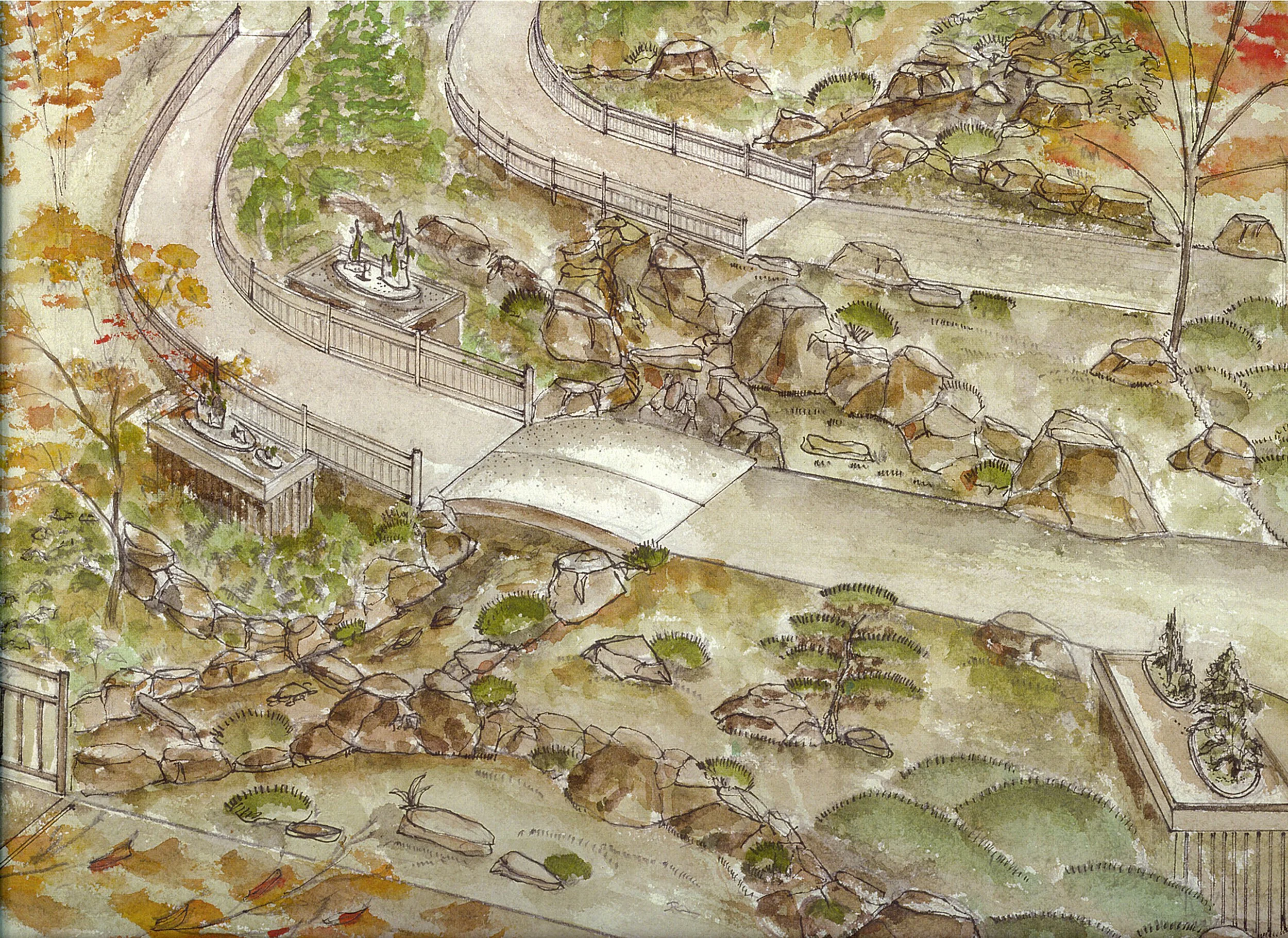
Watercolor paintings done by Mike Oshita to illustrate his vision for the bonsai garden
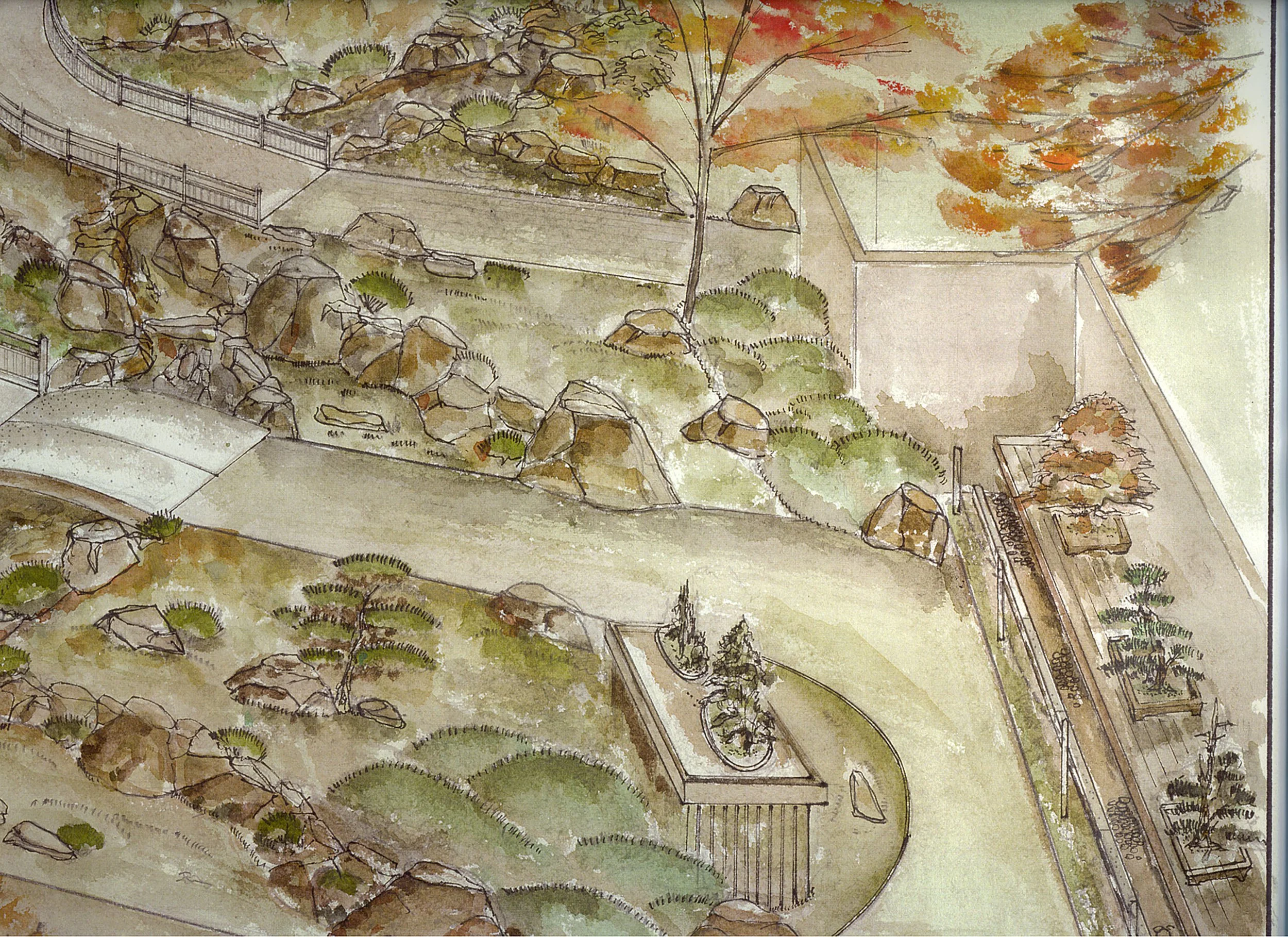
When it came to Mike's plant selections, however, I had some reservations. He conscientiously tried to use a few native plant species, but he reflexively relied heavily on the Asian plants with which he had greatest familiarity. Those of us on the team who had horticultural expertise suggested specific native plant substitutions for some of the more traditional plants Mike picked and he accommodated those requests. We wanted to be respectful, so we were judicious about messing too much with Mike's work and limited our requests for alteration. In the end, the original plant palette for the garden was still heavily weighted toward plants you might expect to find in a Japanese garden. I saw this and thought better of making a case out of it, not wanting to upset the apple cart of harmony. The discrepancy was on my mind, though, and I made a mental note of it.
The entire design effort played out over the course of more than two years, and by the end of it everyone involved was ready to call it a wrap. I could never have guessed at all the minutia, the fine-grained level of detail it was necessary to figure out and decide upon. It had been a fairly exhausting process. I think everyone involved might have wished the design could be tweaked a little this way or that based on their own personal preference, but taken altogether there was a general good feeling about the work we accomplished.
A moment of truth came at the very end, when Executive Director George Briggs asked Bill Dechant if he had a cost estimate for the project. Bill smiled and slowly opened a folder and drew out a sheet of paper, handing it to George. "The way I figure it,” he said, “it'll take between a million and a half and two million dollars to get you there." George didn't reveal much of a reaction while he surveyed the estimate. I, on the other hand, just about blacked out.
Two million dollars?!? Where is that kind of money going to come from?